

In the last month two pieces of ANTSIE work have been published. First, analysis of several years of snow petrel tracking from Dronning Maud Land showed that early in the breeding season there is a very large foraging range (>1500 km) but that as the season progresses and the sea ice retreats closer to the coast, the snow petrels also forage closer to shore. This work shows us how closely related to the sea ice the snow petrels are, but also that our interpretation of the sea-ice environments in the stomach-oil deposits should be mindful of the large area of sea ice the snow petrels are potentially sampling.

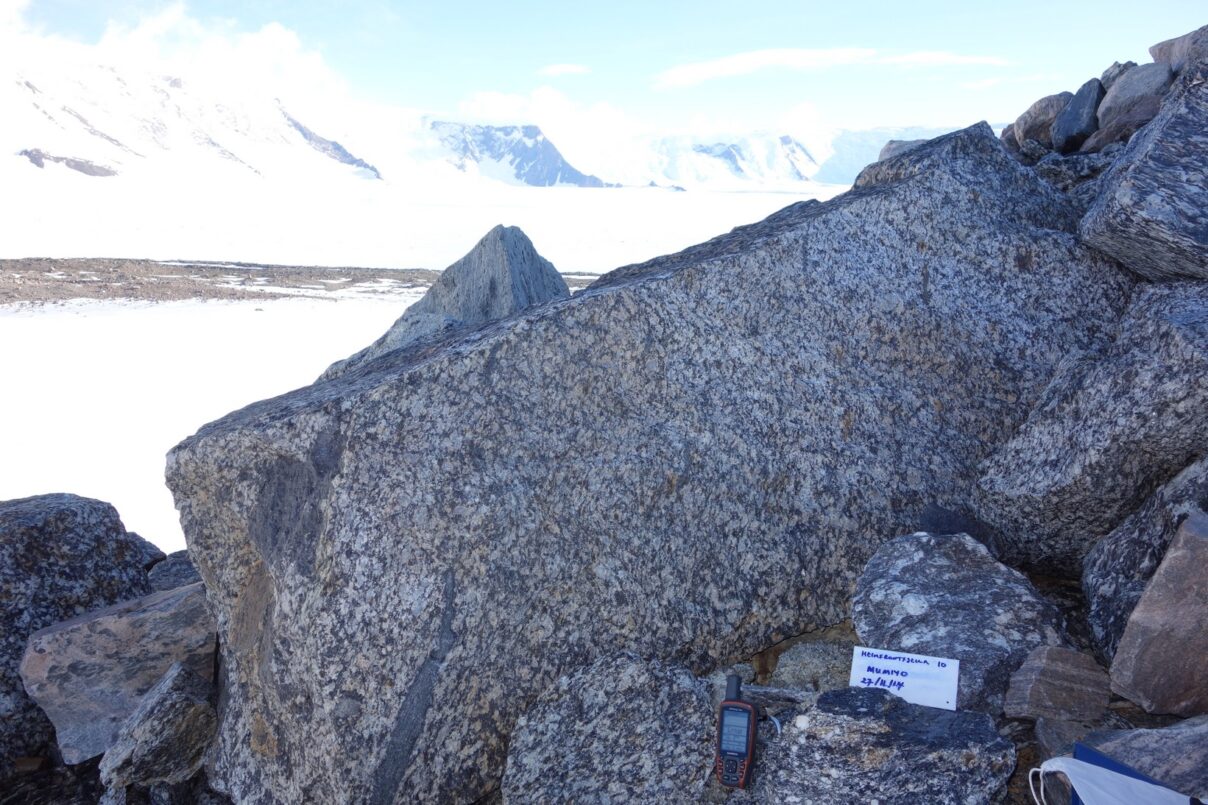
Second, we applied our knowledge of modern snow petrels to reconstruct changing diets and sea-ice environments during the most recent period of geological time, the Holocene (the last 11,700 years). Over this interval there has been variability in the extent of sea ice, which we detected in the stomach-oil deposit recovered from Heimefrontfjella, in Coats Land, East Antarctica.
To read more:
Wakefield, E., McClymont, E., Descamps, S., Grecian, W.G., Hoelzel, A.R., Honan, E.M., Rix, A.S., Robert, H., Sandøy Bråthen, V. and Phillips, R.A. (2025) Variability in foraging ranges of snow petrels and implications for breeding distribution and use of stomach-oil deposits as proxies for paleoclimate. Movement Ecology 13, 83. https://doi.org/10.1186/s40462-025-00609-7
Stevenson, M. A., Hodgson, D. A., Bentley, M. J., Gröcke, D. R., Tunstall, N., Longley, C., Graham, A., and McClymont, E. L. (2025) Mid-Holocene sea-ice dynamics and climate in the northeastern Weddell Sea inferred from an Antarctic snow petrel stomach oil deposit, Clim. Past, 21, 2465–2483, https://doi.org/10.5194/cp-21-2465-2025.